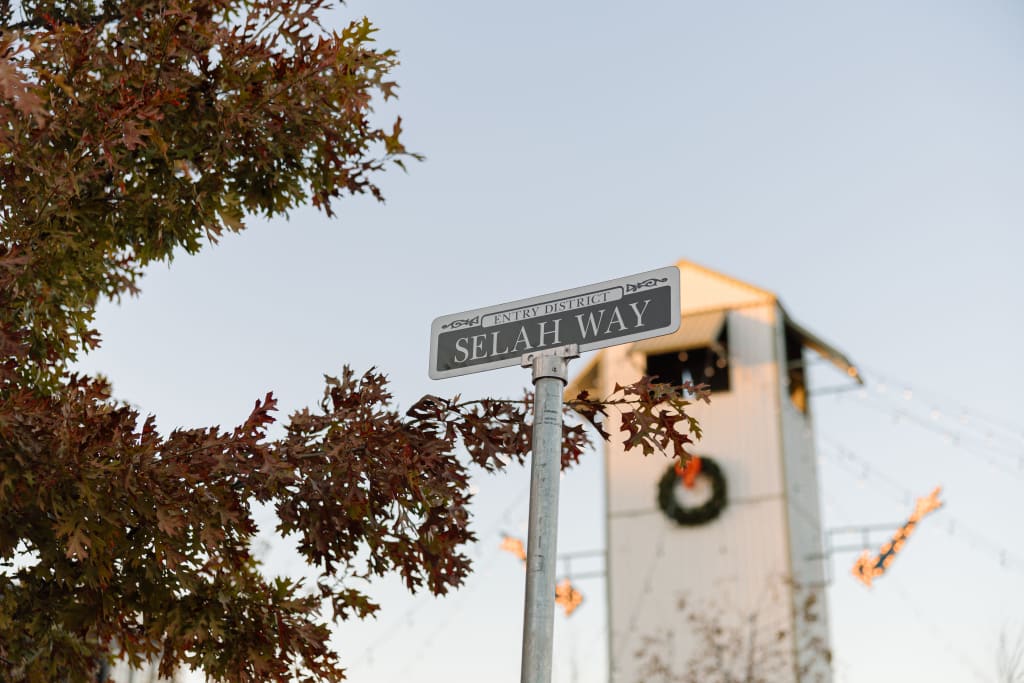
Selah: Designed to Belong | Volume II - Walkability: The Shortcut to a Better Life

I think a lot of us assume community should happen naturally.
If the neighborhood is good, if the people are friendly, if everybody has the right intentions, then connection should just sort of take care of itself.
But that’s not usually how it works. Because even when people want community, they still need somewhere for it to happen. That’s what public space is really about.
Not empty land.
Not leftover land.
Not decorative land.
But the kinds of places people actually use — parks, greens, plazas, sidewalks with somewhere to lead, and those everyday gathering spots often called “third places.” And the truth is, a lot of neighborhoods don’t suffer from a lack of good people. They suffer from a lack of good places.
Let’s be real. A lot of developments technically have “public space.” There may be a patch of grass. A bench. A small concrete area. Maybe even a sign out front describing it like it’s a major amenity. But everyone knows the difference between a place that exists… and a place that works. A public space that works is one people actually want to use.
Not because they were told to.
Not because there’s an event once a quarter.
Not because it looks nice in a rendering.
But because it feels welcoming on a normal Tuesday.
That’s the problem with so many modern neighborhoods: the shared spaces are often treated like extras instead of essentials. And when that happens, people don’t linger. They don’t gather. They don’t build the small, repeated interactions that turn strangers into neighbors. That’s the critical point: community needs more than proximity. It needs places that invite presence.
This gets easier to understand when you stop thinking like a planner and start thinking like a person.
A public space that works feels like:
a park where families actually stay instead of just pass through
a shaded bench where someone can sit without feeling exposed or out of place
a small green where kids can move freely and adults can talk without needing a formal reason
a plaza that feels alive because people naturally cross paths there
a coffee shop, lawn, courtyard, or main-street corner that becomes part of somebody’s routine
It doesn’t have to be fancy. It just has to feel usable. That’s what makes “third places” so important. They’re the spaces outside home and work where life can happen casually. Where you can show up without a big plan. Where connection can grow without pressure.
Because most community isn’t built in major moments.
It’s built in ordinary ones.
One of the most practical truths in New Urbanism is that shared life depends on shared spaces.
Not abstractly. Physically.
If a neighborhood wants connection, it needs places where connection can take root. That’s why New Urbanism cares so much about parks, greens, plazas, front porches, civic spaces, and third places that are woven into daily life.
What makes those spaces work usually comes down to simple things:
They’re easy to reach. People don’t have to make a special trip.
They feel comfortable. Shade, seating, visibility, and human scale matter.
They feel safe. People are more likely to linger when a place feels watched over and well-used.
They give people a reason to stay. Not just pass by.
They support informal interaction. No ticket, no invitation, no schedule required.
That’s what good public space does. It lowers the social barrier. It gives people a place to be human around each other. And that matters more than we sometimes admit, because trust rarely starts with deep conversation. Usually, it starts with recognition. Familiarity. Repetition. Seeing the same faces enough times that a nod becomes a hello, and a hello becomes a relationship.
At Selah, this matters because public space isn’t separate from community. It’s one of the main ways community is formed. If we care about belonging, then we have to care about whether people have places to belong together. If we care about well-being, then we have to care about the everyday environments people move through. If we care about stewardship, then we have to create places worth caring for. And if we care about long-term vitality, then we can’t build neighborhoods where private life is the only life. Selah’s values point toward something deeper than development for development’s sake. They point toward places where daily life feels grounded, connected, and shared.
That doesn’t happen by accident.
It happens when public spaces are treated like part of the neighborhood’s heart — not its leftovers.
A village doesn’t work because people are magically more neighborly there. It works because the structure of the place makes interaction more natural. There are places to gather. Places to pause. Places to see and be seen. Places where age groups mix. Places where everyday life overlaps.
That’s what public space does when it’s done well. It gives the village somewhere to show up. Without that, even a walkable neighborhood can feel incomplete. Because sidewalks matter, yes. But sidewalks by themselves are just connectors. They help people move. They don’t always help people stay.
A real village needs both.
It needs paths that make connection possible and places that make connection meaningful.
Be honest:
Is there a place in your neighborhood where people naturally gather?
Is there somewhere nearby you’d actually want to sit, linger, or run into someone?
Do children, parents, and older adults all have a space that feels like it belongs to them too?
Are your shared spaces active and welcoming, or mostly empty and symbolic?
If someone asked where community happens in your neighborhood, would you have an easy answer?
Those aren’t just design questions. They’re quality-of-life questions. Because a neighborhood can look complete on paper and still feel socially unfinished in real life.
Next in the series, we’ll look at something that shapes whether a neighborhood feels memorable or generic: local character and identity.
Because community gets stronger when a place doesn’t just function well.
It also feels distinct. Rooted. Recognizable.
Not like anywhere else.
But like here.
People need more than private space.
They need shared space that feels human.
Places where life can spill out a little.
Places where routines can overlap.
Places where belonging has somewhere to land.
At Selah, that’s part of what it means to design for community.
Because sidewalks alone don’t build connection.
They simply make it possible to reach the places where community can form.
Sign in with your email address
You’re being redirected to the page with listing data.